


Updated October 2026 · Six2Eight Product Design Team
SaaS product design in recent year is about reducing cognitive load, putting AI inside the core workflow, and getting users to value faster. The 9 trends that define it are calm dashboards, command palettes, role-based interfaces, AI-native workflows, guided activation, trust and explain ability UI, accessibility by default, data-dense design systems, and outcome-led pricing UX.
We design SaaS dashboards for founders and product teams across fintech, real estate and logistics. Below is each trend, what it means, why it matters, and a product doing it well.
The SaaS market is projected to reach $375.57B by 2026 (Fortune Business Insights), with products competing through better experiences, onboarding, and workflows. This guide breaks down each trend with real product examples and the metrics.
SaaS Product Design Trends 2026 at a Glance
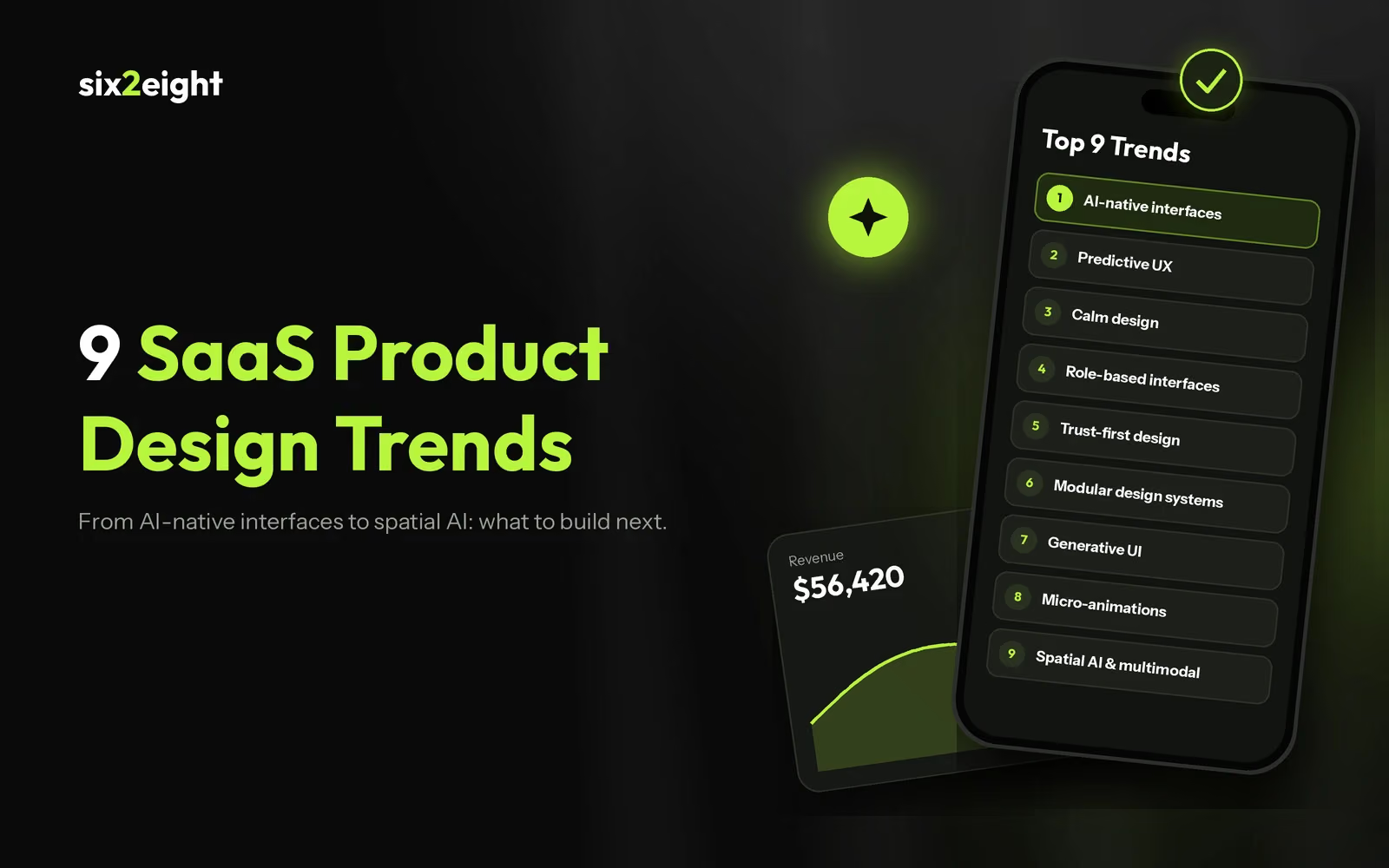
The 9 SaaS product design trends for 2026 are AI-native interfaces, predictive UX, calm design, role-based interfaces, trust-first design, modular design systems, generative UI, micro-animations, and spatial AI.
| # | Trend | What it is | Key UX pattern | Real example |
|---|---|---|---|---|
| 1 | AI-native interfaces | AI built into the core workflow, not a side chatbot | Intent input, AI plans and executes, human approves | Revive AI (Six2Eight) |
| 2 | Predictive UX | Software anticipates the next action from usage data | Suggested next steps, smart priorities | Linear |
| 3 | Calm design | Shows only what matters now to cut cognitive load | Progressive disclosure, priority alerts | Notion |
| 4 | Role-based & adaptive interfaces | Layouts and tools change by user role and behavior | Role-specific dashboards and views | Figma viewer vs editor |
| 5 | Trust-first design | Makes AI decisions visible, explainable and reversible | AI previews, confidence indicators, approval steps | AI lead-score explanations |
| 6 | Modular design systems | Reusable components that scale without design debt | Shared component libraries, design tokens | Figma Dev Mode |
| 7 | Generative UI | Interface assembles itself per user context | AI-generated layouts and components | Context-built dashboards |
| 8 | Micro-animations | Motion that confirms actions and shows system state | Progress indicators, save confirmations | Workflow status transitions |
| 9 | Spatial AI & multimodal | Voice, image, file and text inputs trigger actions | Upload + natural-language request | Notion AI file summaries |
Why SaaS Product Design Has Shifted From Screens to User Outcomes
SaaS product design is no longer just about creating attractive interfaces. It focuses on user behavior, faster activation, and business outcomes by using AI, personalization, and adaptive workflows to reduce friction and improve retention. Research from McKinsey shows that companies with stronger design capabilities outperform competitors in revenue growth and shareholder returns.
These shifts are shaping the next generation of SaaS products, influencing how interfaces are built, how users interact with software, and how companies design better digital experiences. Below are the key 9 SaaS product design trends defining this evolution.
Trend 1: AI-native SaaS interfaces
AI-native interfaces are changing how users interact with SaaS products. Instead of manually searching through menus and completing every step themselves, users can describe goals and allow AI systems to assist with planning, recommendations, and execution.

How Agentic AI Workflows Are Replacing Traditional SaaS Interactions
Agentic AI workflows shift the interaction model from clicking through menus to stating intent. The old model required users to select a feature, perform an action, and receive output. The new model accepts user intent, reasons through a plan, executes the workflow, and requests human approval only at key decision points.
In modern SaaS platforms, these intelligent assistants do not just answer questions; they proactively manage data analysis, content creation, task prioritization, and automated business setups.
Gartner predicts that 40% of enterprise applications will feature task-specific AI agents by the end of 2026, up from less than 5% in 2025. Also, predicts that more than 80% of enterprises will have used generative AI APIs, models, or deployed GenAI-enabled applications

AI Transparency Builds Trust in Automated Actions
As AI takes more responsibility, users need confidence before approving important actions. Therefore, modern SaaS products are adding AI previews, explanations, and approval steps so users can review recommendations before execution. Finally, this balance between automation and human control is becoming essential for trustworthy AI-powered SaaS experiences.
Real Product Example:
Revive AI project demonstrates an AI-native SaaS approach by embedding intelligent automation and AI-driven interactions directly into the product experience, helping users achieve outcomes faster instead of relying on traditional interface flows.
AI handles the execution, but a truly intelligent product goes one step further and predicts what the user needs before they ask, which is where predictive UX begins.
Trend 2: Predictive UX
As SaaS products become more intelligent, predictive UX allows software to anticipate user needs instead of only reacting to commands. By using behavioral data, usage patterns, and context, SaaS platforms are improving how users discover information and complete workflows.
Real-World Predictive UX Examples in Modern SaaS Products
Many SaaS products already use predictive UX through recommendations, automated suggestions, and smart workflows. Project management tools can suggest task priorities based on deadline proximity and team capacity. CRM platforms recommend follow-up actions based on deal stage and contact history. Analytics products highlight important changes before users manually search for them.
These patterns reduce time spent finding information and increase time spent making decisions. Instead of navigating through multiple steps, users receive relevant suggestions based on what they are likely trying to achieve.
How Predictive UX Reduces User Effort and Decision Fatigue
Modern SaaS platforms contain many features, options, and data points. While flexibility is valuable, too many choices can slow users down. Predictive UX reduces this by prioritizing relevant actions and removing unnecessary decisions. Users need clear reasons behind recommendations and the ability to adjust suggestions when needed. That transparency requirement is why predictive UX overlaps directly with trust-first design.
Real example:
Linear predicts the next action a developer needs based on the current sprint state, issue status, and recent activity. The interface surfaces what matters now rather than displaying every available option.
Prediction works best inside an interface that does not overwhelm users with everything at once, and that is exactly the problem calm design solves.
Trend 3: Calm Design
As SaaS products become more powerful with AI, automation, analytics, and advanced workflows, complexity has become a major usability challenge. Calm design is emerging as a key SaaS product design trend because it helps users focus on important actions without feeling overwhelmed.

How Progressive Disclosure Keeps SaaS Interfaces Simple
Progressive disclosure reduces friction by revealing features only when they are relevant. This approach aligns with cognitive load theory and Hick’s Law: more choices visible at once means slower, less confident their decisions become. Instead of exposing every tool in the interface, strong SaaS products surface the core action first and layer in advanced controls through context, user role, or task progression.
In AI-powered products, where complexity can grow quickly. A CRM, for example, may show lead details and next-best actions upfront while keeping automation rules, integrations, and advanced reporting behind secondary interactions. The result is faster onboarding, clearer navigation, and better activation because users reach value without feeling overwhelmed.
How Attention-Focused SaaS Design Improves User Productivity
Attention is now one of the scarcest resources in SaaS. Users move between dashboards, alerts, and workflows while managing constant interruptions. Attention-focused design uses contextual dashboards, priority-based notifications, and personalized layouts to reduce scanning time and keep users on task.
The strongest products are not the ones that show everything at once. They organize information around intent. By filtering noise and highlighting what matters now, SaaS interfaces can improve productivity without adding visual clutter.
Notion is the clearest example of calm design done right. Its interface hides formatting tools, database options, and AI features behind a single command, showing users only what they need, exactly when they need it.
Reducing complexity is more powerful when the interface already knows who the user is, which is the core principle behind role-based adaptive design.
Trend 4: Role-Based & Adaptive Interfaces
Modern SaaS products serve multiple users with different responsibilities, workflows, and goals. Role-based and adaptive interfaces deliver personalized experiences while keeping the interface simple and efficient for each user type.

How Role-Based Interfaces Improve SaaS User Experience
Role-based interfaces tailor SaaS experiences to each user’s responsibilities, showing only the tools, data, and actions they need. This reduces cognitive load, speeds up workflows, and improves onboarding in complex B2B products. For example, executives may see summaries, while analysts access detailed controls. The result is clearer navigation, higher adoption, and less training effort across teams and enterprise SaaS environments.
Appcues research shows that optimized onboarding improves user activation and engagement by helping users reach product value faster.
How Adaptive Interfaces Shape the Future of SaaS Personalization
Adaptive interfaces personalize SaaS experiences by adjusting dashboards, recommendations, and workflows based on user behavior and context. This approach aligns closely with broader trends in SaaS UI/UX personalization. Instead of searching for features, users receive more relevant actions at the right time. As AI adoption grows, adaptive interfaces are becoming an important approach for creating more personalized and efficient SaaS experiences.
Real Example:
Figma separates the viewer experience from the editor experience: stakeholders who only need to review and comment see a simplified interface, while designers accessing all editing tools see the full environment. This separation reduces confusion and improves collaboration adoption across non-design team members.
Personalization at this scale only holds up when users trust that the system is making decisions in their interest.
Trend 5: Trust-first design
As AI becomes more involved in SaaS workflows, trust is becoming a major product design challenge. Users may appreciate automation, but they also need confidence that AI decisions are accurate, understandable, and controllable.
Why AI Autonomy Requires New Trust Patterns in SaaS UX
Traditional SaaS interfaces usually respond directly to user action. AI-powered systems are different because they can recommend decisions, generate outputs, and take actions with less manual input. This creates a new design requirement: users need visibility into what the AI is doing and why. Modern SaaS products are addressing this through approval steps, activity histories, confidence indicators, and editable AI suggestions.
These patterns help users stay involved while still benefiting from automation. For businesses, stronger trust can improve AI adoption because users are more likely to rely on features they understand.
How Explainable AI Interfaces Reduce User Uncertainty
Explainable AI focuses on making AI behavior easier to understand. Instead of showing only the final result, SaaS interfaces can provide context, reasoning, or supporting information behind recommendations. For example, an AI sales assistant can explain why a lead is prioritized, or an analytics tool can show which data influenced an insight. As AI capabilities expand, trust-first design will become increasingly important for creating SaaS products that balance automation with user control.
Teams looking to implement these ideas can learn from real-world SaaS product design case studies to understand how modern UX decisions affect adoption, engagement, and business outcomes.
That trust is only maintainable across a growing product when the design system underneath is modular, consistent, and built to scale without breaking.
Trend 6: Modular Design Systems
As SaaS products grow, adding new features while maintaining consistency becomes increasingly difficult. Modular design systems are becoming essential because they help teams build flexible, scalable, and reliable product experiences.

Why Modular Design Systems Improve SaaS Scalability
A modular design system gives a SaaS product structure that can grow without falling apart. Instead of designing every screen element from scratch. Teams reuse proven components, patterns, and rules to build new features faster and more consistently.
For users, the product feels familiar from screen to screen. For teams, designers and developers move faster because they are not rebuilding the same pieces. For the business, updates ship more efficiently, and the product scales without creating design debt that erodes user trust over time.
Forrester’s Total Economic Impact study found that Figma Dev Mode delivered a 351% ROI over three years by improving design-to-development workflows, reducing friction, and increasing team collaboration.
How Reusable Components Accelerate Future SaaS Development
Reusable components help SaaS teams adapt products faster by allowing navigation patterns, dashboards, forms, and workflows to be improved once and reused across multiple areas. This reduces complexity and supports faster experimentation. As AI-generated interfaces and personalization grow, modular design systems will become essential for maintaining flexibility and consistency.
A scalable system creates the foundation, but generative UI takes it further by letting the interface assemble itself dynamically for each user in real time.
Trend 7: Generative UI
Generative UI allows interfaces to assemble dynamically based on user context rather than relying on fixed layouts. Instead of every user seeing the same screen, the product builds the right view for the right user at the right moment.
How Generative UI Creates Personalized SaaS Experiences
Traditional SaaS interfaces provide the same structure for every user. However, different users often need different information, workflows, and levels of complexity. Generative UI addresses this by allowing interfaces to adapt based on user goals, context, and tasks. For SaaS companies, it creates opportunities to improve engagement and deliver more personalized product experiences at a scale that manual design cannot achieve.
SaaS companies are increasingly adopting AI in customer-facing workflows, with AI-powered support tools helping teams automate responses, reduce resolution time, and improve customer experiences.

How AI-Generated Components Are Shaping SaaS Design
AI-generated components are still an evolving area, but they show potential for helping teams create flexible interfaces faster. Instead of manually designing every variation, teams can explore systems where AI assists in generating layouts or workflow suggestions. However, maintaining consistency, accessibility, and user control remains an important design challenge. The next stage of this trend will likely focus on balancing AI flexibility with reliable product experiences.
Dynamic interfaces need one more layer to feel complete motion that confirms actions, communicates system state, and makes transitions feel intentional.
Trend 8: Micro-Animations for feedback
Microanimations are becoming an important SaaS design pattern because modern products increasingly rely on complex workflows, automations, and AI-powered actions. Small motion details help users understand what is happening inside the interface.

How Micro-Interactions Improve Feedback in SaaS Products
Many SaaS actions involve invisible processes, such as saving information, processing requests, or generating results. Because these actions happen behind the scenes, users may feel uncertain about whether the system is working correctly. To address this, micro-interactions such as progress indicators, status changes, and subtle transitions help communicate system responses more clearly. As a result, they improve clarity and make workflows feel more predictable.
Research shows that emotionally engaging product experiences and thoughtful interaction design can improve user confidence, satisfaction, and perceived product quality, which can support stronger retention.
Best Practices for Purposeful Motion Design
Effective motion should support usability rather than simply decorate the interface. Modern SaaS products use SaaS motion design and micro-animation to guide attention, explain changes, confirm actions, and make complex workflows easier to understand. Every animation should have a job: confirm a save, indicate a process running, guide the user to the next step, or communicate that an action was received. Animation without a functional purpose adds cognitive load rather than reducing it.
When every interaction layer is optimized from structure to motion, the next frontier is expanding where users interact beyond the screen itself.
Trend 9: Spatial AI and Multimodal Interaction
Spatial AI represents the next evolution in how users interact with SaaS products. Rather than confining all interaction to clicks and keyword input, spatial AI enables voice, visual, and contextual inputs to trigger actions, retrieve information, and update workflows. For SaaS products, this means users can interact with complex systems through the most natural method available to them at any given moment.

Why Multimodal Interaction Is Moving Into B2B SaaS Workflows
SaaS interfaces are moving beyond dashboards and menus as AI enables users to interact through text, voice, images, and context-aware inputs. Multimodal interaction allows users to describe goals naturally, analyze documents, or trigger actions without navigating complex workflows. Unlike basic voice commands, spatial AI understands workflow context, available actions, and user intent, making interactions more intelligent and adaptive.
Where Spatial AI Is Already Shipping in SaaS Products
Early adoption of multimodal experiences is happening in field operations, healthcare, analytics, and enterprise tools, where users need faster access to information. SaaS products are using AI to analyze files, generate insights, create reports, and capture data through natural interactions, reducing dependency on traditional screen-based workflows.
The Design Challenge: Context, Accuracy, and Trust
The biggest challenge with spatial AI is ensuring users understand what the system interpreted before taking action. SaaS products must prioritize transparency, confirmation steps, previews, and recovery options. Trust becomes a core design requirement because users will adopt AI workflows only when they feel confident about the system’s decisions.
Real Example:
Notion’s multimodal input lets users upload a document, describe what they need in plain language, and receive a structured summary or action plan without navigating a single menu. The interaction combines text, file context, and natural language into one unified workflow. That is spatial AI moving from field tools into mainstream SaaS.
Together, these nine trends point toward the same outcome: SaaS products that reduce friction, build trust, and grow alongside the users who depend on them.
FAQ
How does SaaS product design directly reduce churn?
SaaS product design reduces churn by removing friction during onboarding, feature discovery, and key workflows. Since many users abandon products before reaching value, better onboarding, progressive disclosure, and role-based experiences help users understand the product faster and increase the chance of long-term retention.
What is the difference between SaaS product design and general UI/UX design?
SaaS product design goes beyond individual screens; it focuses on complex workflows, user roles, onboarding, dashboards, and long-term adoption. While general UI/UX improves usability, SaaS product designers optimize the complete journey from first login to retention and business outcomes.
Why is onboarding design critical in SaaS products in 2026?
Onboarding decides whether users experience value or leave early. Modern SaaS onboarding uses personalization, behavioral signals, and guided experiences to help users reach their first meaningful action faster instead of overwhelming them with setup steps.
What is AI-native interface design in SaaS?
AI-native interface design means AI is built into the core SaaS workflow instead of being added as a separate chatbot or feature. Users can describe goals naturally, and the product helps with execution, recommendations, and automation, changing how they interact with the software.
Conclusion
SaaS product design is increasingly focused on intelligence, adaptability, and user-centered workflows. From calm design and predictive UX to generative interfaces and trust-first experiences, these trends reflect a broader shift toward software that understands user intent and reduces complexity. While not every trend will apply equally to every product, SaaS companies that prioritize usability, personalization, and transparency will be better positioned to improve engagement, accelerate adoption, and create digital experiences that evolve alongside user needs.
With 25+ years in UI/UX and web development, I’ve seen what makes users stay and what makes them leave. Most design issues aren’t just visual; they’re about clarity and flow. At six2eight, we craft intuitive experiences that turn frustration into engagement and clicks into customers. Let’s build something that works.
Get Creative More Efficiently